
A Republican, Democrat, and Libertarian walk into a bar. The bartender asks what they want to drink. The Republican says, “I’ll have a beer.” The Democrat says, “Sounds good. Me too.” The Libertarian nods and says, “Make that three.” They clink glasses. Then they sit and talk to each other about ideas without personal attacks. No joke. This is how it should be.
America is deeply entrenched in a two-party system with a third party trailing behind, capturing some important ideas the other two neglect. Each party has ideas worth listening to. Each party has flawed ideas.
This system naturally creates an “Us vs Them” dynamic and naturally leads to views that are “Pro-this” or “Anti-that”. But I think if we reframe how we see political parties we’re all smart enough to sit in a bar or a coffee house and talk over drinks. No belief system can hold the complexity of who we are.
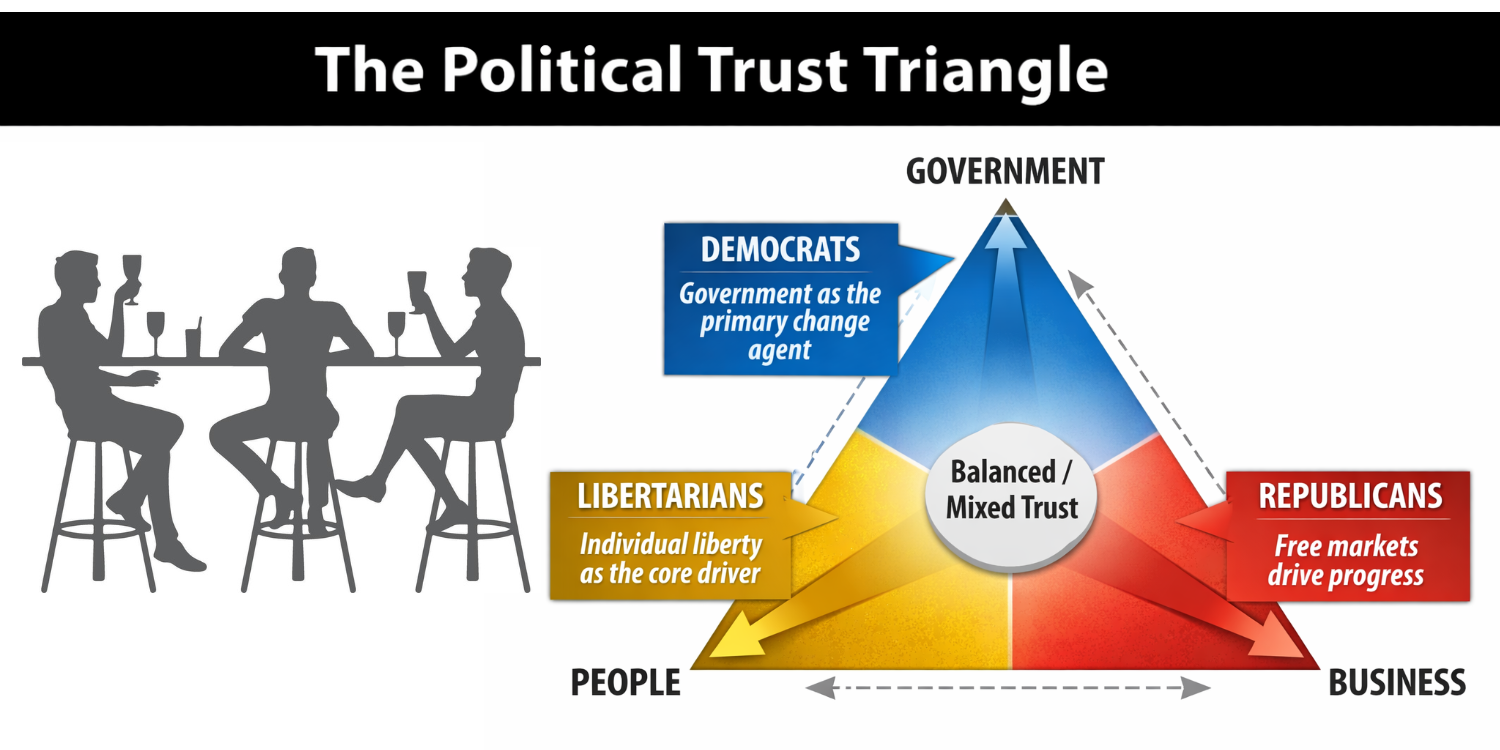
If you look at the core principles of those three parties based on who they trust and don’t trust, we can create what I call a “Political Trust Triangle”. This gives us a chance to move away from the right/left dichotomy and its natural tendency toward polarization. Once we move away from a model with inherent polarization, some interesting dynamics become clear.
All the parties have an extensive platform but below is a basic generalization about their core beliefs that differentiate them from each other.
The traditional Republican party is pro-business and believes free markets will self-regulate. They advocate for small government and minimal regulations.
The Democrats feel big business can get carried away and needs to be regulated to protect the workers, consumers and the environment. They advocate for government regulations on food, health, education, public transportation, social welfare, worker’s rights and more.
The Libertarians believe the people should have extensive personal freedom and minimal, if not zero, taxation. Like the Republicans, this naturally leads to believing in a small government.
Below is the ‘Political Trust Triangle‘ where each party is represented in a portion of the triangle and their ‘change agent’ labeled at the apex.

Of the three political parties referenced in this diagram, none have a monopoly on the truth. They are not fully right, and they are not fully wrong. They all offer wisdom we should take seriously, and they all offer folly we should take even more seriously because it can be used as a manipulation tool. The value of this representation is that it removes the edges of political identity and allows us to place ourselves within the triangle instead of absolutes or right/left.
Change agents
We all see changes that need to be made in our country and world, and we vote for the party that will make the changes that most closely align with our vision of the country and world we want to live in. Let’s look at each apex of the triangle with the concept of change agent in mind.
People – I’m intentionally putting this one first because I wanted to believe that people could be the primary change agent for positive change in the world. Yes, we can find that to some degree but for all of human history, people are the creators of the problems. Too many people cannot escape their primal drives. Fear is a powerful motivator. Greed, territory, sex, and power are as prevalent in many people today as they were when humans lived in caves. Wars are still fought over resources. Greed still creates a scarcity model that leaves people in poverty. People can read the same religious text and form completely different religious sects that have almost nothing in common and then feel so strongly about their interpretation that they are willing to kill. As much as I want to believe in the good of humanity but, as a systemic change agent, people are the least effective and possibly the most dangerous choice. In many cases, people call for personal freedom as long as it is their freedom to do what they want. In the same breath, they call for limits to the personal freedom of people with beliefs they feel threaten theirs.
Business – The primary goal of business is profit. You can find cases where businesses are involved in the community, donate to charities and other actions that show motivations past profit, but they will not sacrifice profits for those and many times altruistic actions are as much about marketing as they are about helping.
Profits as the only metrics of success can be disastrous once you move outside of the scope of the business. One example stands out to me. In the 1960s and 1970s industrial waste and sewage devastated Lake Erie and parts of it were declared dead. In 1969, Cleveland’s Cuyahoga River, which feeds into Lake Erie, caught on fire because of all the oils in it. With profits in mind, the easiest and cheapest way to dispose of waste was to dump it in the lake.
One way for a company to control cost and increase profits is through the control of its resources. And what is one of the most expensive resources? Humans. We have human resource departments to manage this resource just like a company that has other departments to handle resources such as office supplies. When there is an economic downturn, it’s time to manage resources better. Buy less pencils and get rid of people.
Systemic change for the good of our country and world cannot come from business whose only measurement of success is profit. In fact, many companies spend a large amount of money lobbying the government to pass laws that favor them but hurt people, communities and the environment.
Government – People love to blame the government for their problems and they are absolutely right. It is an untamed beast. In 1863 Lincoln gave the Gettysburg Address with the line “government of the people, by the people, for the people”. As I stated earlier, getting large numbers of people to agree is an extremely unlikely endeavor. We need no more proof than when Lincoln gave the address, people were killing each other over the difference in belief as to the right to own other people. (And yes, it was over slavery. If you question that, reading each state’s articles of secession can put that to rest.) Yet, with all the problems with the government, it is the only apex with the inherent ability for systemic change. Lake Erie is thriving now because the government stepped in and started regulating industrial waste and sewage. At one point, a company was marketing a weight loss product. It was tape worm eggs. Yes, it was effective in weight loss, but I think most people support government regulations that make products like that illegal.
From this, we can see that two of the apexes are not ideal as systemic change agents and the only one that is, is highly flawed. Where does that leave us?
It leaves us at “government of the people, by the people, for the people” but with a different mindset. If you look at the Political Trust Triangle, you’ll see there are not three choices: Democrat, Republican, and Libertarian. The triangle creates a two-dimensional area where you can place yourself. It is not the either/or of the one-dimensional left/right line. Self-labeling as one of the three ‘tribes’ creates a false division that inevitably leads to an “us against them” mentality. With that comes the idea that for someone to win someone has to lose. It is only after we abandon that highly flawed philosophy that people will truly become viable change agents.
The Political Trust Triangle allows us to move away from identity politics and start addressing issues on their merits. Once we can remove the tribal ‘us vs. them’ identity we start realizing we agree more than we disagree and talk about our differences over a beer or coffee. We stop letting well-crafted, but totally unfounded, political rhetoric sway us into division.
My dad once told me laws are created to address problems and that has always stuck with me. If you go back to Lake Erie, government regulations were created to solve the problem. Later on, the Environmental Protection Agency (EPA) was created to enforce the laws created to protect the environment. For other issues outside of the environment, we can start listing government acronyms such as ATF, FBI, FDA, and more, that were created to enforce laws that were created in response to problems.
The government is a reactive change agent.
The Republican apex wants a smaller, limited government. The Libertarian apex wants a smaller, limited government. How do we achieve that? The answer is easy. Stop creating the need for a larger government. If we were able to do that, I don’t believe you would hear Democrats complaining. The only reason they want a large government is to solve problems and they see the government as the only viable change agent.
If laws are created to solve a problem, it follows that once people and corporations start self-regulating, start acting proactively, the reactive nature of the government diminishes and the large overreaching arm of the government starts pulling back. Once corporations move past profits as the sole measure of success, once they start seeing people, communities, the environment, consumers as equal to profit, everything changes. And they still make a profit and possibly increase profits. No one loses and everyone wins.
This is not at all unfounded. Wal-Mart’s sustainability initiatives in the early 2000s is a great example. Part of the initiative was to push truck manufacturers to increase fuel efficiency. Because of this they doubled fleet efficiency from 2005 to 2015 and saved nearly one billion dollars. It was a win for them, a win for other companies using trucks and a win for the environment. No one lost. They were also early adopters of LED lights. They installed more than 1.5 million LED fixtures across more than 6,000 stores, parking lots, distribution centers and corporate offices in 10 countries, reducing lighting energy costs by more than $100 million. This helped drive down the cost of LED lights and made them more affordable for you and me. They won, other businesses won, you and I won and the environment won.
The government sets Corporate Average Fuel Economy (CAFE) standards on manufactures. This was done in 1975 after the Arab Oil Embargo. The goal was to improve fuel economy to reduce the dependence on foreign oil and address greenhouse gases. In the Wal-Mart example, a corporation basically did the same thing. If consumers demanded more efficient vehicles, if large corporations demanded more efficient vehicles, automotive manufacturers would naturally react to meet the consumer demands.
That is an example of the People apex acting as the change agent and the Business apex being reactive to that demand. But what if the automotive manufacturers’ themselves didn’t wait for the demand and preemptively acted? What if they saw stewardship of the planet as important as profit? What if they saw wars being fought over oil and other resources as something they could help minimize? What happens then is we have removed fuel economy as a political issue and the government steps out of the arena because the fight is irrelevant. Both Republicans and Libertarians have achieved the goal of less government regulation. No one has lost anything, we all have lower gas bills, and the cost of transporting goods is reduced, which helps with inflation.
There is a lot of contention over environmentalism because it has become a political issue. But why? Who is against high gas mileage vehicles, clean air, and clean water? No one is against that but they are against an overreaching government. The shift in philosophy from the Political Trust Triangle removes environmental concerns as a political issue, no one loses and everyone wins.
The center of the triangle is labeled “Balanced Trust”. If we could move towards a balanced trust, all three apexes become equally valued, and each one is capable of systemic change. Each apex has valuable ideas that should be used when a voter goes to a poll. The triangle makes self-labeling and absolute party loyalty illogical because ideas are judged on their merits instead of a letter attached to them. That is the goal.
The cognitive dissonance of saying, “I am a Democrat” or “I am a Republican” or “I am a Libertarian” is much more powerful than people realize. Even if you make that statement based on one political platform point, your mind automatically creates a bias towards the other platform points. When that happens, you’re no longer a viable change agent. You are a tool for the political party and easily manipulated. All parties do this. That statement is not a condemnation of any one party. It is a statement of fact.
We are much closer to that than it appears. In a 2025 Gallup poll, 45% of U.S. adults identify as Independents whereas both Republicans and Democrats are 27%. This opens the door for a true change in direction if we can get people communicating and discussing ideas and solutions instead of fighting over political positions.
Changing the Change Agents
I have stated that of the three potential change agents, only one is viable. Let’s look at the potential of the other two and the potential of reducing the role of the government as the primary change agent.
Business as a Change Agent
Earlier, I mentioned what Wal-Mart did with truck fuel economy and LED lights. I’m not advocating for Wal-Mart but in some ways, using them as an example helps my case. They are a massive organization that is known for low-wage jobs without health insurance, and plenty of other behaviors that are solely profit driven. But they deserve notice for their sustainability initiative. The same is true of all our political parties. Some good and a lot of bad which make blind loyalty a character flaw. It is fundamentally imperative that we are open and honest about the party we align our name with. When they are wrong, say they are wrong.
But what would it take for corporate America to become a change agent that works for everyone?
I recently wrote an article about Teal Organizations you can find on LinkedIn and Medium. Teal Organizations become even more fascinating when you look at the Political Trust Triangle.
The Teal organization paradigm moves far past profit as its only metric of success. It starts seeing profit as a byproduct of other factors. Teal organizations feel their employee is not a human resource but a major factor as to why the company exists. I think Greyston Bakery in Yonkers, NY captures this best with their statement “We don’t hire people to make brownies, we make brownies to hire people.” They have an “open hiring” policy with the goal of providing jobs to people who need them. Read more here. The company is profitable and the profits go to support the Greyston Foundation, which helps fund housing, childcare, and health services for people in need. I have heard people say the government should ‘waste’ money on social safety nets. This steps towards reducing the government’s role. Greyston Foundation works with the government through grants to help people in Yonkers.
Patagonia, the outdoor clothing and gear company, has made environmental sustainability central to its mission while building a business with annual revenues of roughly $1 billion. It has also become known for a relatively decentralized organizational culture, with greater employee autonomy and fewer layers of traditional management.
Another paradigm is Conscious Capitalism. Companies following this model view the consumer, employee and environment as an equally important measurement of success as profits. Whole Foods founder John Mackey coined the term and created a highly profitable business while treating the employee, the consumer, the environment and the shareholders well.
Both Teal organizations and Conscious Capitalism create a situation where no one has to lose for someone to win. If corporate America moved in this direction, everything changes. The government is no longer reactively making laws and can step back from its regulatory roles. If corporations saw their community as an indicator of their success, communities and the lives in those communities could be transformed.
Let’s look at an example of how the current two-party system actually works against itself. Think about the business apex. They say they advocate for entrepreneurship, but what is one of the biggest hurdles to starting a new business? Why are people ‘job locked’? The answer: Healthcare cost. Universal healthcare is about as pro-entrepreneurship as you can get. Nothing would drive individuals into the free market faster than knowing they and their loved one’s health needs are met. So why hasn’t it happened? Healthcare became a polarized topic, and lines were drawn in the sand. Every other developed nation has universal healthcare, yet America has people dying and going bankrupt because of a system that is not accessible to so many. I hear people make the excuse that it doesn’t work in other nations. I think you can find failed systems to support that, but you can also find very successful systems. If all the apexes got together and looked at what works and doesn’t work in other systems, America could have the greatest healthcare system in the world. Doctors still get paid adequately. Hospitals still make money. No one goes bankrupt. People don’t die from treatable illnesses because they can’t afford treatment. The insurance companies and drug companies may not fare too well, but those people would have healthcare and have the opportunity to venture into an entrepreneurial endeavor.
Individuals as a Change Agent
This is where things get extremely complicated.
To reduce the size and scope of government and increase personal freedom as the Libertarians want, some things need to happen first and those seem counter to the goal at first.
Educational reform is an absolute must. Quality education lowers crime, unwanted pregnancies, reduces the size and scope of the social safety net, increases income potential, increases community involvement and volunteerism, lowers child abuse rates and so much more.
If moving the change agent from government towards people is the goal, quality education is the highest priority. Putting money into education saves money later. Just from a crime standpoint, it reduces the size and scope of law enforcement which increases personal liberty and freedom.
But how we reform education is critical. Throwing money at it will not fix it.
I have a bachelor’s degree in education and have classroom teaching experience in two states. I haven’t taught for a while, but I now spend a couple of hours a week volunteering in a dyslexia classroom. Education needs comprehensive reform.
Before I get into education reform, to frame things, I want to give a couple of personal examples from when I was a student in elementary school
In elementary school, I vividly remember coloring in sheets with Christopher Columbus shaking hands with Indians and everyone smiling. I was taught about all the wonderful things he did for them. As an adult, I learned something completely different. To verify, I read parts of his journals. He was an awful person. He killed, tortured and enslaved Indians. It has always hurt me to know I was blatantly lied to by people I trusted. The creators of the curriculum knew they were lying to children. Why was this allowed?
Another vivid memory was sitting “Indian style” on the floor. (Maybe that term was brought to us by the same people who lied to us about how great Columbus was.) We had a man talking to us about drugs and alcohol. I grew up in a non-drinking household. My parents didn’t demonize drinking, they just didn’t drink, and never really talked about it. Because of this, when I had friends whose parents drank, it fascinated me. One friend said his parents only drink once a year. Thinking about this as I listened to the adult who was obviously there to teach me something, I raised my hand and asked him what happens if someone only drinks once a year. He told me, and all the children sitting Indian style on the floor with me, that the year would get closer and closer together and they would end up drinking everyday, and becoming alcoholics. That question and his response had a surprisingly powerful effect on me. When I was older and found out he lied to me, that shaped my relationship with alcohol and not in a positive way. Thankfully, I’m not genetically predisposed to alcoholism or his lie to support his agenda could have done some serious damage to me. I often wonder about some of the other children he lied to that day. How much damage did he do by lying because of an agenda?
Both of those examples are where an agenda has usurped education. We are seeing that same fight today. Teaching different points of view is absolutely critical to education but only as an exercise in critical thinking. Schools are responsible for teaching ‘the three R’s’ and we need to add a fourth ‘R’, reasoning. We need a population who can think past propaganda.
Both sides of the fictitious right/left divide worry about indoctrination, and both sides need to worry about it. That is why the fourth ‘R’ is not optional. Students need critical thinking skills; they need to learn to recognize propaganda. Both sides are equally guilty of misdirection and misinformation, and it’s very evident that our school system has absolutely failed in teaching people to recognize it. If we can teach that, the ‘both sides’ go away because they are meritless. Once we have that, people become a viable change agent.
At the same time, a total reform of the criminal justice system from a penal system to a reform system is paramount. A for-profit prison system does not work without people to fill the cells. The US incarceration rate in 2022 was 541 per 100,000 people. Other developed nations fall in the range of 35-120 per 100,000. Getting people into jail and keeping them there is a business. Worse, ‘repeat customers’ are as essential to prisons as they are to any business, therefore recidivism is essential. Focusing on rehabilitation is bad for business.
The US recidivism rate is 70% within 5 years while Norway has a 20% for the same period.
This is a travesty. If you think about it, we have a captive population that is in desperate need of skills, opportunities, education and a chance at a future. Yet, in many cases, they go into prison as mild offenders and come out as hardened criminals. They have received an education in prison but it isn’t one that will reduce the size of the government.
Let’s go back to Greyston Bakery in Yonkers. In 2020 the county government saved $ 4.5 million through reduced recidivism as a result of Greyston’s employment program. Everyone wins.
We All Win
The center of the triangle is “Balanced Trust”. If we can get more people moving in that direction, all three apexes are equally valued and the need to self-label and have absolute party loyalty becomes illogical. A lot of people calling themselves Independents are already there. As more people move there, no one loses and we all gain. Ideas that were once discussed as win-lose situations become discussed on their merits. That is the goal and I believe it is achievable. When we do, the opening line of this article becomes, “Three people go into a bar…”
What next?
That is always the issue with an article like this. There is a lot of information pointing out the problem, but what is the next move? I think the Political Trust Triangle helps us see the next move and that is a change in the language we use and how we identify ourselves. Realize “I am (insert label).” is a limiting statement. If you’re involved in a political party, I don’t expect you to abandon it, but I invite you to examine your motivation and guard against the tribal “us vs. them”. In our politically divided world, that is a big ask. Blind loyalty is a disease. It stops us from standing up against something that is wrong because it calls our loyalty into question. No solution is possible until the only loyalty that isn’t called into question is our loyalty to truth and the future of humanity. All other loyalties should be questioned.
I have an article called Death and Destruction by Single Issue Voterswhich is obviously about the problems caused by a narrow focus. When we vote on one issue, we give politicians free rein on all other issues, turning a position of public service into one for personal gain. Our world is too complicated for a narrow focus. As a voter, we need to be looking at character of the politicians more closely than campaign promises. Only after we start electing politicians who are willing to look for solutions instead of pushing political propaganda with their next election in mind, will we start transforming our government into a “government of the people, by the people, for the people”.
We also need to remember our second voting system. Our money. Each dollar we spend is a vote for a business and a product. If we want to push the business apex towards a system that doesn’t demand regulation, we are the driving force for that. It is my personal preference to vote downstream as far as possible. I chose to buy from people whose names I know, putting money into my local economy. The people at the local hardware store say, “Good Morning, Will,” when I walk in. I also buy laundry sheets and toilet paper from companies with sustainability as a business model.
Finally, talk, discuss, listen and be willing to be wrong. I firmly believe that staying quiet is complacency. If you believe things are wrong, say so. But, after you have an open and civil discussion, if you are wrong, admit it and change your stance. This isn’t a contest; this is the construction of our shared future. We are building a world that works for all of us.


Leave a Reply